

In nature, animals may exhibit variations in colouration within the same species. Whilst some of these variations are relatively common, others are rare and may be associated with genetic, physiological or environmental changes.
Albinism is one of the best-known conditions, characterised by the absence or extreme reduction of pigmentation, which gives the animals’ fur a whitish colour. Other disorders affecting the colouration of wild animals, however, are still poorly understood by science.
A study led by Leonardo Cotts, a researcher at CE3C, has identified, for the first time, cases of xanthochromism in ring-tailed coatis (Nasua narica), a colouration anomaly that gives the animals a hue ranging from yellow to orange-yellow.
Recently published in the scientific journal Mammalia, the study documents two ring-tailed coatis (Nasua nasua) with unusual colouring, observed in Tijuca National Park, Rio de Janeiro, Brazil. Instead of the brown and greyish colouring typical of this species, the animals had a predominantly yellow coat.
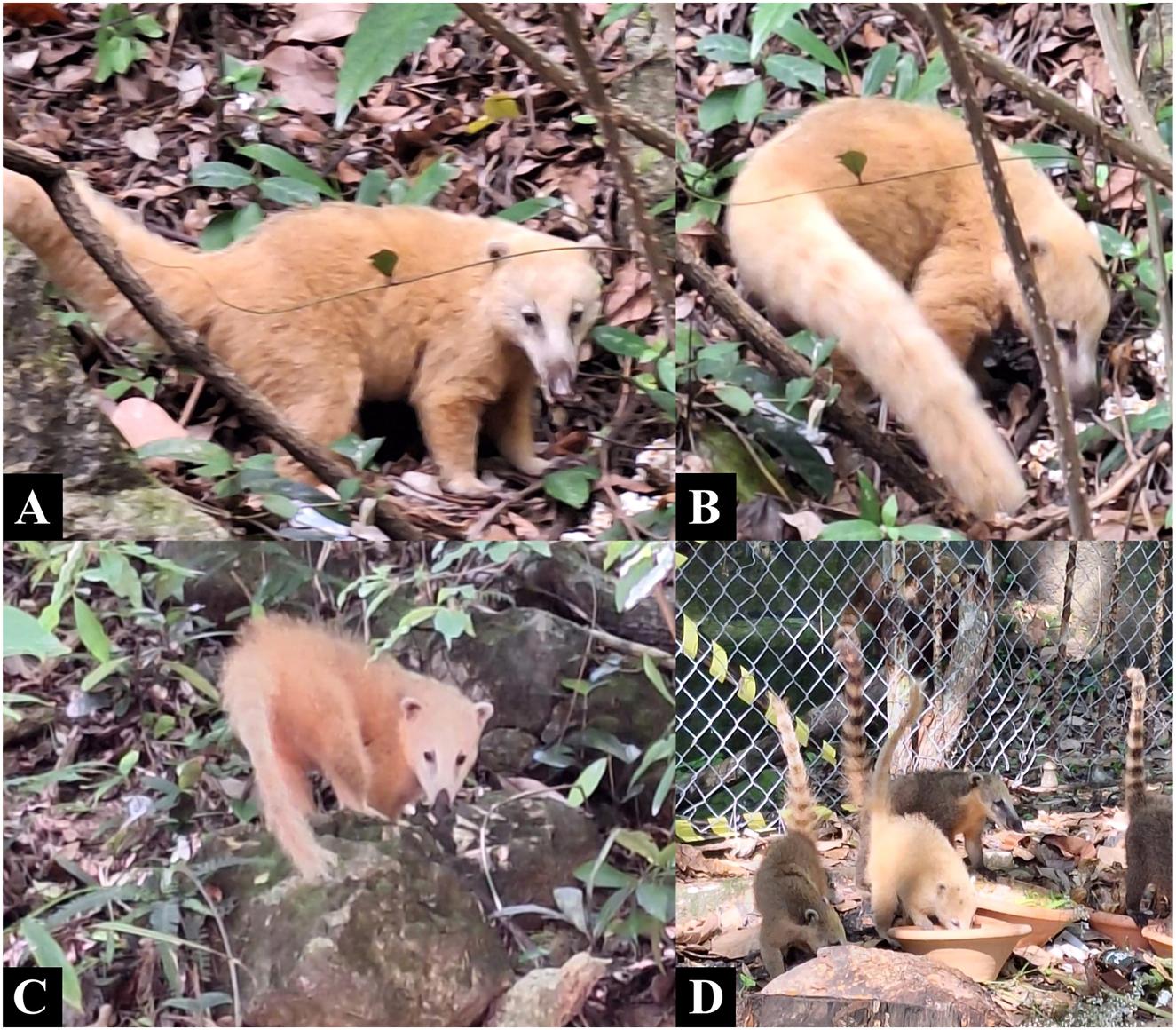
This colouration is a chromatic disorder known as xanthochromism, caused by a reduction in dark pigments (eumelanin) in the coat of these mammals and a greater abundance of light pigments (pheomelanin)."
Leonardo Cotts
According to researcher Leonardo Cotts, the two individuals with xanthochromism were observed on separate occasions, including at times when they were in the company of coatis with typical colouring. The observations took place in Tijuca National Park, in Rio de Janeiro, Brazil, one of the world’s largest urban forests. Interestingly, these xanthochromic animals were only sighted on the outskirts of the park, where urban influence is most pronounced; on some occasions, they were observed feeding on the remains of ritual offerings left at the site.
The researchers highlight the possible link between heavy human pressure on ecosystems and the emergence of colour anomalies, but stress that it is not yet possible to conclude that environmental conditions are responsible for this change. Further studies and new observations will be needed to better understand the origin and the way in which these phenomena arise.

Environmental disturbances associated with forest edges, such as microclimatic changes, urban expansion, the isolation of groups and a reduction in gene flow between populations, may be contributing to the emergence of colouration anomalies, such as xanthochromism."
Leonardo Cotts
According to the researcher, this is an unprecedented and particularly important finding, given that colouration anomalies in coatis are still poorly understood. Identifying these colouration anomalies could contribute to a better understanding of the state of ecosystems, as these animals can serve as bioindicators of environmental changes, including pressures caused by human activities.
Related News
view all 47 s
Este estudo reforça a necessidade de melhores práticas científicas e de bem-estar animal.
13 May 2026

Portugal na frente de combate ao comércio ilegal de espécies na União Europeia
24 Jan 2024

A study published in Scientific Reports (part of the Nature Portfolio) brings good news, but scientists warn of the need to maintain active protection strategies
11 Sep 2026
An international study reveals that butterfly species perceived as the most beautiful receive greater public and scientific attention and are over-represented in some European conservation measures.
21 Sep 2026