

Biofertilizers for Sustainable Agriculture: nourishing our soil, cultivating our future
25 Jan 2024
Location: Room 2.2.14 - Faculty of Sciences of the University of Lisbon
Plant-Soil Ecology

06 Mar 2025
Room 2.2.14 - Faculty of Sciences of the University of Lisbon & Online
12h00 (Lisbon time)
Pierre Lesturgie (CE3C-EGB)
Online access · LINK
Password · scientia
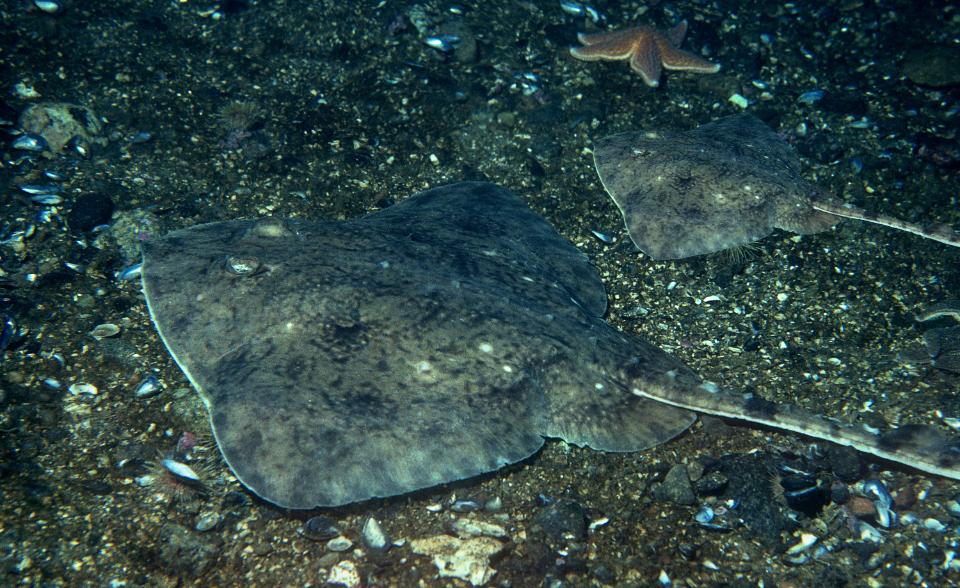
The thorny skate (Amblyraja radiata) is a commercially important species inhabiting the North Atlantic Ocean. While fishing stopped in the Northwest Atlantic (NWA), the Canadian (CAN) population displayed swift recovering but not the Gulf of Maine (GoM) population. The species exhibits size a disparity across its range, with a “small” morph inhabiting the entire range and a “large” morph restricted to the NWA. Whether this is due to the co-occurrence of two species and whether this is related to population recovery remains debated.
Here, we whole genome sequenced 49 individuals from the entire range distribution. Population structure analyses highlighted two distinct geographic clusters (NWA and Northeast Atlantic – NEA), but no genetic structure within NWA. Extensive coalescent-based modelling provided additional insights into the demographic history of the species and discarded the two-species hypothesis by showing strong migration between GoM and CAN. However, genomic scans in the NWA highlighted the presence of a ~31 Mb supergene with two alleles (HB and HS). A screening of 500 individuals for the two alleles demonstrated (i) a larger size HB/HB (~57 cm) and heterozygotes (HB/HS, ~56 cm) than for HS/HS (~41 cm); and (ii) a positive assortative mating in GoM but not in CAN. We finally discuss the presence of an extinction vortex caused by an Allee effect in GoM, making this study a rare case of association between a supergene and the population trajectory in a Vulnerable population.
Related Events
25 Jan 2024
Location: Room 2.2.14 - Faculty of Sciences of the University of Lisbon

22 Nov 2018
Location: Room 2.4.16 - Faculty of Sciences of the University of Lisbon

16 Feb 2023
Location: Online