
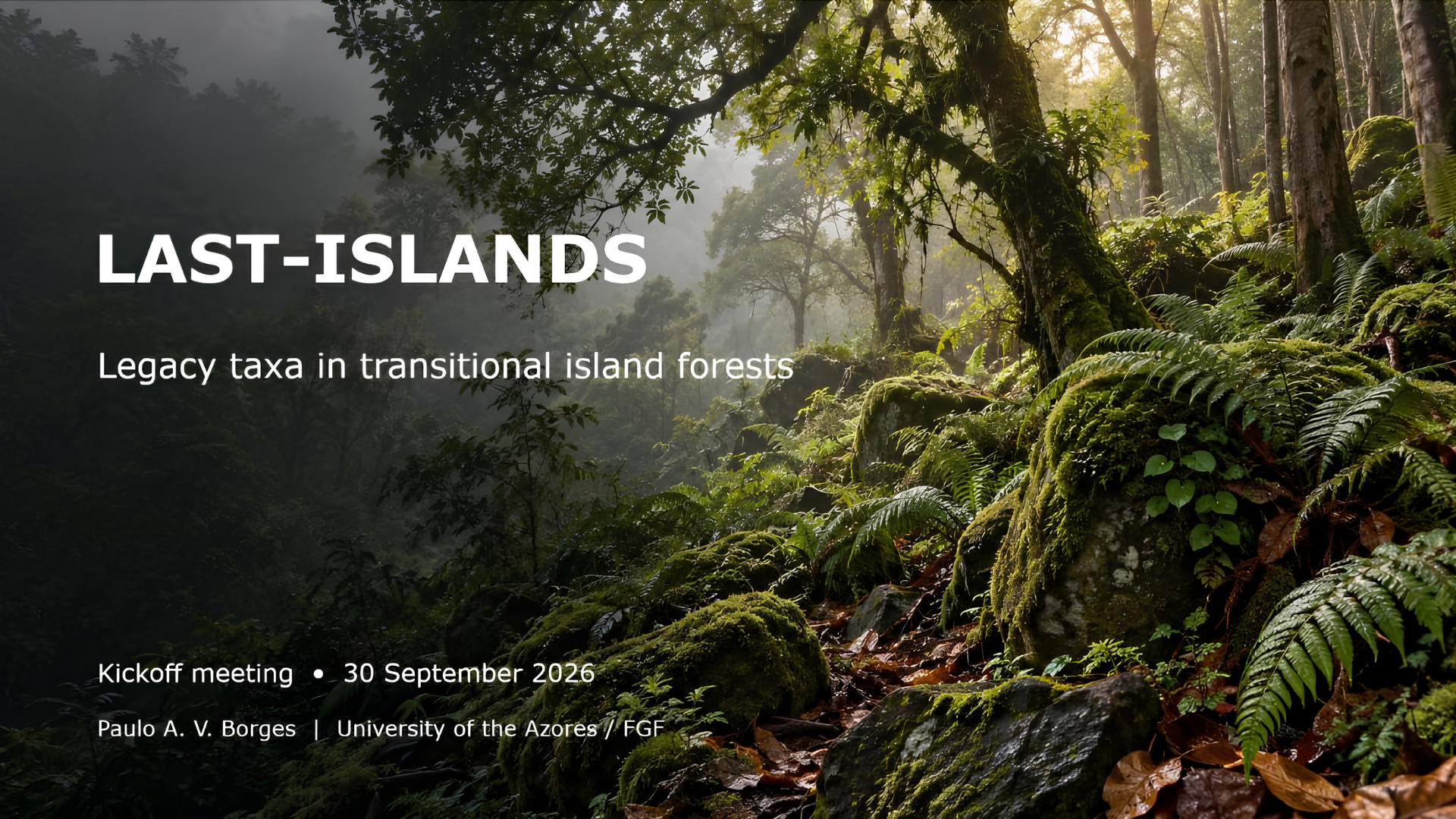
When a rare species persists in a forest altered by human activity, does this mean it has found a lasting refuge, or that its population is on the verge of disappearing? This is one of the central questions addressed by LAST-ISLANDS – Legacy tAxa Survivors in Transitional ISLAND Systems, a scientific project launching in the Azores at the end of September which aims to understand the conditions under which native and endemic species are able to persist in exotic forests and other habitats undergoing transition.
The project is led by the Azores Biodiversity Group at the University of the Azores, which forms part of CE3C – Centre for Ecology, Evolution and Environmental Change – and is coordinated by researcher Paulo Borges. Running for 36 months, the LAST-ISLANDS project receives financial support of up to 300,000 euros from the Belmiro de Azevedo Foundation, through a collaboration agreement with the Gaspar Frutuoso Foundation and the University of the Azores.
LAST-ISLANDS addresses a question with direct implications for biodiversity conservation: can exotic forests and transitional habitats act as genuine refuges for native species, or are they merely preserving residual populations that may disappear in the future? The project aims to distinguish between populations capable of persisting and isolated populations that may be subject to what is known as an ‘extinction debt’.
The research will draw on existing data, primarily from Terceira Island, and will be extended to the islands of São Miguel, Santa Maria, São Jorge, Pico and Flores, covering different contexts of exotic forests and habitats in transition. The study will pay particular attention to spiders, beetles and bryophytes, such as mosses, integrating ecological, landscape, taxonomic and genetic data. Throughout the project, the team will seek to identify which landscape and habitat characteristics favour the persistence of these species and to assess the role of factors such as the size and connectivity of forest patches, vegetation structure, moisture levels and proximity to areas of native forest. The results will be used to develop decision-support models and maps capable of identifying areas where restoration, ecological connectivity or monitoring may be priorities. In addition to scientific output, LAST-ISLANDS plans to make data available via open access, produce scientific publications, issue conservation recommendations and organise an exhibition dedicated to the ‘hidden’ biodiversity that persists in the transformed landscapes of the Azores.
The project therefore aims to contribute to a more comprehensive understanding of biodiversity in the Azores and to provide scientific evidence to support future conservation decisions, particularly in the management of habitats, ecological restoration and the enhancement of connectivity between natural areas.
Related News
view all 24 s
O projeto visa enfrentar o aumento da população de siluro na Europa Ocidental, incluindo Portugal.
12 Dec 2022

Foi oficialmente aprovado o Plano de Ação para a Conservação e Sustentabilidade dos Polinizadores em Portugal.
02 Apr 2026

Reinventar a democracia com as pessoas nos 50 anos do 25 de Abril e no caminho para as eleições europeias
11 Apr 2024
Evento decorre já esta quarta-feira, 18 de abril, às 17h30, no Museu Nacional de História Natural e da Ciência.
17 Apr 2023