
-
Date:
From 14 Jun 2027 until 18 Jun 2027
-
Deadline for Applications:
14 May 2027
-
Location:
Museu Nacional de História Natural e da Ciência (MUHNAC)
-
Duration:
36 hours (contact hours)
-
Schedule:
09h00-12h30 and 14h-17h30, Monday-Thursday; 09h00-13h00 and 14h00-18h00, Friday
-
Lecturer or Responsible:
Ricardo Jorge Lopes (CE3C-BEC, CIÊNCIAS), Judite Alves (CE3C-NHC&S, MUHNAC), Pedro Andrade (MUHNAC), Ana Campos (MUHNAC)
-
Nº (min - max) Students:
10-15. Note: the course may open with less students when at least 3 BIODIV students enroll; this gives them additional responsibilities to take the course and should communicate immediately after the deadline for applications if they are not able to atend
Objectives:
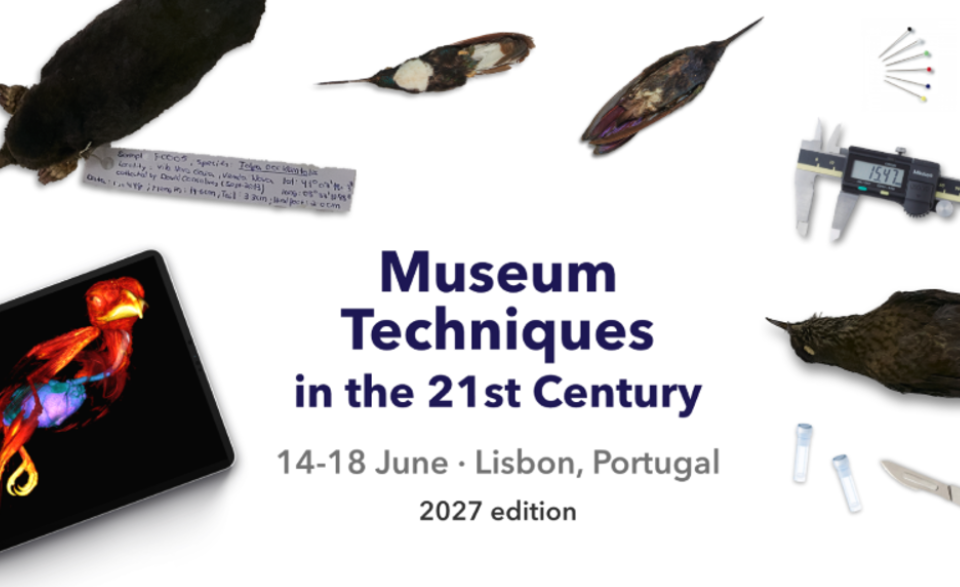
This course aims to provide an updated vision of the potential of museum collections for biodiversity research. More specifically aims to:
1) use theretical sessions, practices and invited case studies on the value of museums and the use of collections and specimens in the 21st century, using new technologies and analytical methods. These include, among others:
a) present the “extend specimen” concept, and the potentially limitless use of Biological collections;
b) discuss state-of-the-art ‘whole specimen’ techniques including CT scanning, 3D models, 3d printing;
c) consider how museum specimens provide genetic and genomic resources and how to retrieve genomic data from historical specimens;
d) present non-genetic molecular methods (e.g., stable isotopes, toxicology and quantification of color);
e) understand the potential of the spatial and temporal data gathered along with the specimen, available in global repositories, such as GBIF and the power of machine learning techniques to mobilize data from specimens;
2) practice the ways that vouchers of vertebrates can be prepared to ensure that quality data is available for generations to come;
Participants have to be present at 85% of the contact hours (this means that they can miss one half-day), and actively participate in all activities.
This course can give credits to PhD programmes at CIÊNCIAS or of programmes with partnership from CIÊNCIAS and other institutions with 6h-7h of contact hours per ECT, as a function of specific requirements. For these students additionally to the exercises done during the week the delivery of a written report done after the course is mandatory. For programmes with less hours of contact per ECT (6h/ECT, getting 6 ECTs from the course) students need to do an additional assignment (summary report). If needed 1 or 2 additional hours of contact may be added. Such report(s) are also advised for other students requesting creditation of the course in their institutions.
Directed to: Students interested in the preservation and use of biological specimens.
Minimal formation of students: Bachelor in Biological and Natural Sciences or related areas
General plan
Monday
09:00 Value of museum specimens in the 21st century
- the use of Biological collections
- the principle of the “extended specimen”
- current methods for preparing specimens
10:30 Invited lectures
- case studies on “whole specimen” approaches, including CT scanning and 3D models
14:00 Practical
- preparation of digital vouchers
- quantification of coloration
- photogrammetry and 3D printing
Tuesday
09:00 Museum specimens as genetic & genomic resources
10:30 Invited lectures
- case studies on the use of genetic data from museum specimens
14:00 Practical
- best practices for obtaining, transporting and storing genetic material from vertebrate sources
- the flow of data in the MUHNAC biobank
Wednesday
09:00 Museum specimens as resources for non-genetic molecular analysis
10:30 Invited lectures
- case studies on the use of non-genetic molecular analysis data from museum specimens
14:00 Practical
- preparing voucher specimens
Thursday
09:00 Museum specimen’s data as resources for biodiversity analysis
10:30 Invited lectures
- case studies on the use of museum data for biodiversity analysis
14:00 Practical
- data validation and curation for public repositories
- data retrieval and filtering from public repositories
Friday
09:00 Practical
- preparing voucher specimen
14:00 Practical
- MUHNAC collections - types of specimens and storage
Fees
Free for 1st year PhD students in Doctoral programmes at CIÊNCIAS (e.g. Biologia), Biodiversity, Genetics and Evolution (BIODIV UL; UP) and Biology and Ecology of Global Changes (BEAG UL, UA), when the course counts credits for their formation, in which case the delivery of a final report done after the course is mandatory; the course is also free for more advanced PhD students of the BIODIV programme (ULisboa or UPorto); 60 € for more advanced PhD students of CE3C; 100 € for PhD students of the PEERS network not from CE3C (CFE); 150 € for CIÊNCIAS Master students and unemployed; 200 € for BTI, BI and other PhD students with scholarship; 300 € for Professional and postdocs.
When the maximum number of students is reached, 10 vacancies will be available for non-paying 1st year PhD students mentioned above, being, by order of preference students from: 1) CE3C; 2) BIODIV (not from CE3C); 3) CIÊNCIAS (not from CE3C); 4) BEAG (not from CE3C or CIÊNCIAS).
How to Apply
Candidates should fill in the APPLICATION FORM, which will be available in this section when the call opens.
This form is strictly confidential and will only be used for the purposes of this application.
When filling the form mind to:
- FILL ALL THE MANDATORY FIELDS
- UPLOAD CV AND MOTIVATION LETTER, both mandatory.
For any doubts please contact the coordinator of the CE3C courses Inês Fragata (irfragata@ciencias.ulisboa.pt) or the course coordinator, Ricardo Jorge Lopes (rjlopes@ciencias.ulisboa.pt)
