-
Date:
18 Dec 2025
-
Location:
Online
-
Schedule:
11h30 (Lisbon time), 10h30 (Azores time)
-
Lecturer or Responsible:
Ricardo Costa (IBBC-CE3C)

Online access* • LINK
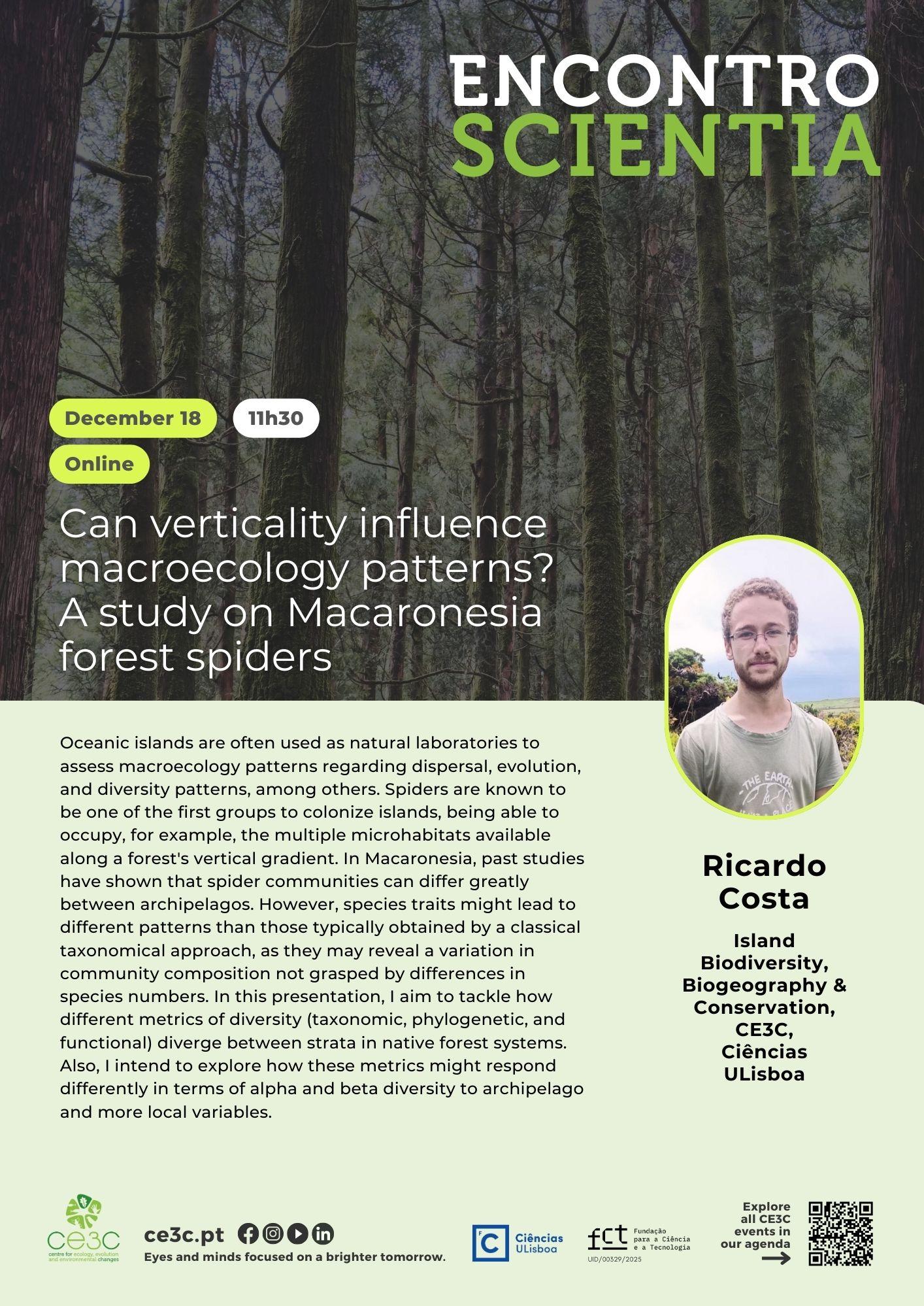
Oceanic islands are often used as natural laboratories to assess macroecology patterns regarding dispersal, evolution, and diversity patterns, among others. Spiders are known to be one of the first groups to colonize islands, being able to occupy, for example, the multiple microhabitats available along a forest's vertical gradient. In Macaronesia, past studies have shown that spider communities can differ greatly between archipelagos. However, species traits might lead to different patterns than those typically obtained by a classical taxonomical approach, as they may reveal a variation in community composition not grasped by differences in species numbers. In this presentation, I aim to tackle how different metrics of diversity (taxonomic, phylogenetic, and functional) diverge between strata in native forest systems. Also, I intend to explore how these metrics might respond differently in terms of alpha and beta diversity to archipelago and more local variables
* To access the meeting in the app without using the link, use the meeting ID 331 089 008 409 47 and access code Lt2hh2MW