-
Date:
13 May 2026
-
Location:
Room 2.2.14 - Faculty of Sciences of the University of Lisbon & Online
-
Schedule:
16h00 (Lisbon time), 15h00 (Azores time)
-
Lecturer or Responsible:
Mafalda Dias & Jonathan Frazer

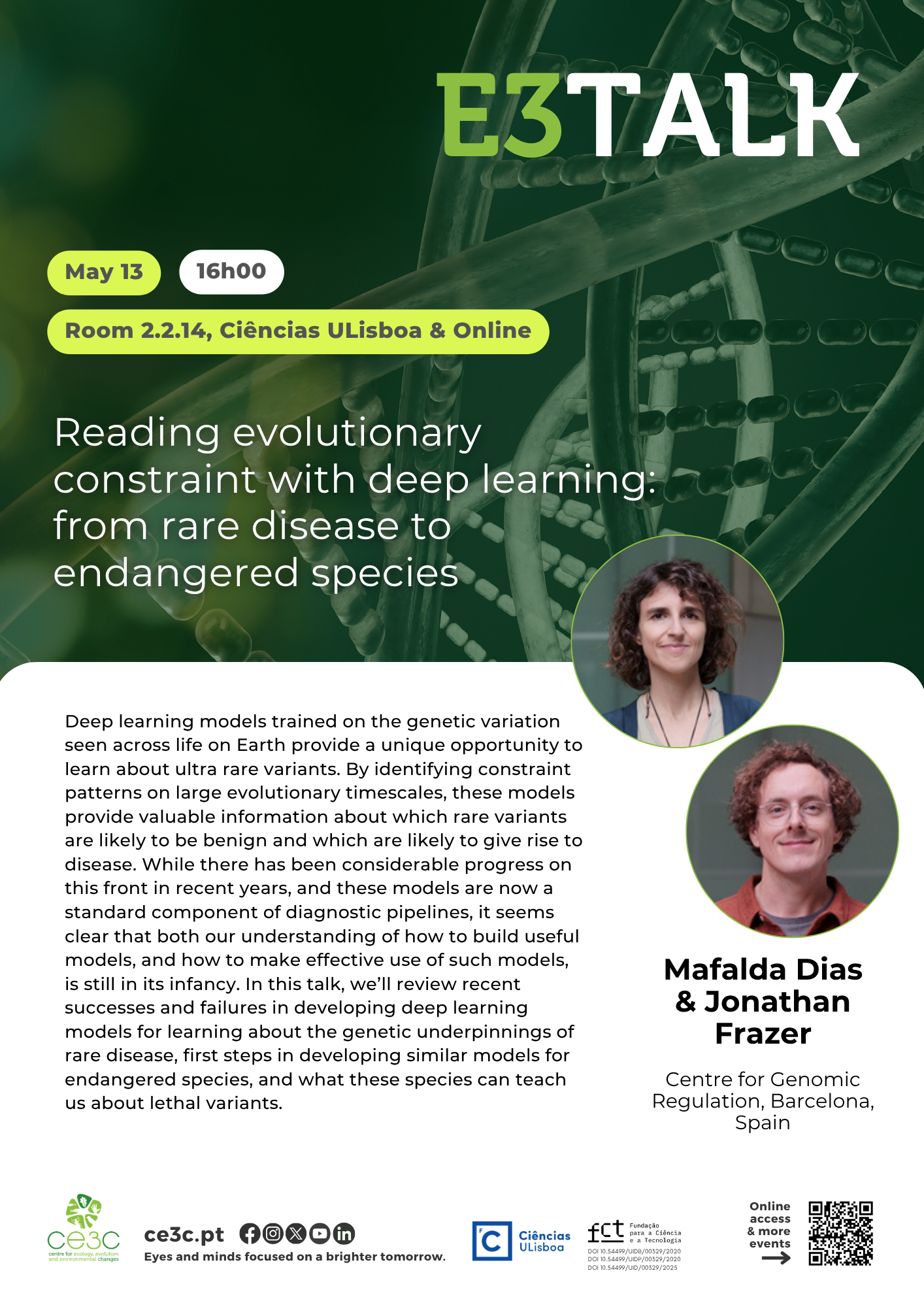
Deep learning models trained on the genetic variation seen across life on Earth provide a unique opportunity to learn about ultra rare variants. By identifying constraint patterns on large evolutionary timescales, these models provide valuable information about which rare variants are likely to be benign and which are likely to give rise to disease. While there has been considerable progress on this front in recent years, and these models are now a standard component of diagnostic pipelines, it seems clear that both our understanding of how to build useful models, and how to make effective use of such models, is still in its infancy. In this talk, we’ll review recent successes and failures in developing deep learning models for learning about the genetic underpinnings of rare disease, first steps in developing similar models for endangered species, and what these species can teach us about lethal variants.
Online access* • LINK
*To access the meeting in the app without using the link, use the meeting ID 386 422 363 693 456 and acess code cC6oX9Wz

Mafalda Dias (Centre for Genomic Regulation, Barcelona, Spain)

Jonathan Frazer (Centre for Genomic Regulation, Barcelona, Spain)